
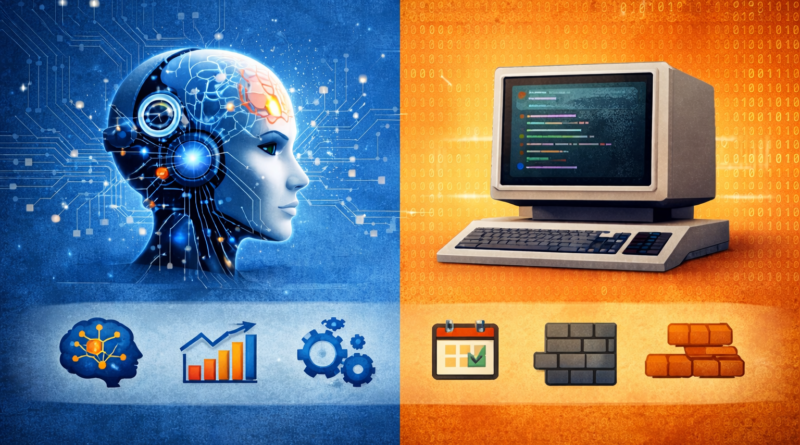
AI Tools vs Traditional Software – Key Differences
AI tools vs traditional software is one of the most discussed topics in today’s digital world.
When people compare AI tools vs traditional software, they are really asking how modern intelligent systems differ from the rule-based programs we have used for decades.
In simple words, traditional software follows fixed instructions written by humans, while AI tools can learn from data, adapt to new situations, and improve over time. This article explains the meaning, importance, working process, benefits, risks, common myths, and frequently asked questions related to AI tools and traditional software. Whether you are a beginner, student, business owner, or tech enthusiast, this guide will help you understand the real differences clearly and practically.
Meaning / Explanation
To understand AI tools vs traditional software, we first need to define both concepts clearly.
Traditional software is built using predefined rules, logic, and workflows. Developers write code that tells the software exactly what to do in specific situations. If the input changes or an unexpected condition occurs, traditional software cannot handle it unless the developer has already programmed a response. Examples include calculators, spreadsheet applications, basic accounting software, inventory systems, and older desktop applications.
AI tools, on the other hand, are software systems that use artificial intelligence techniques such as machine learning, deep learning, natural language processing, and computer vision. Instead of relying only on fixed rules, AI tools analyze large amounts of data, identify patterns, and make decisions or predictions based on learned behavior. Over time, they can improve their performance without being explicitly reprogrammed.
For example:
- A traditional email filter works based on predefined spam rules.
- An AI-powered email filter learns from user behavior and improves spam detection automatically.
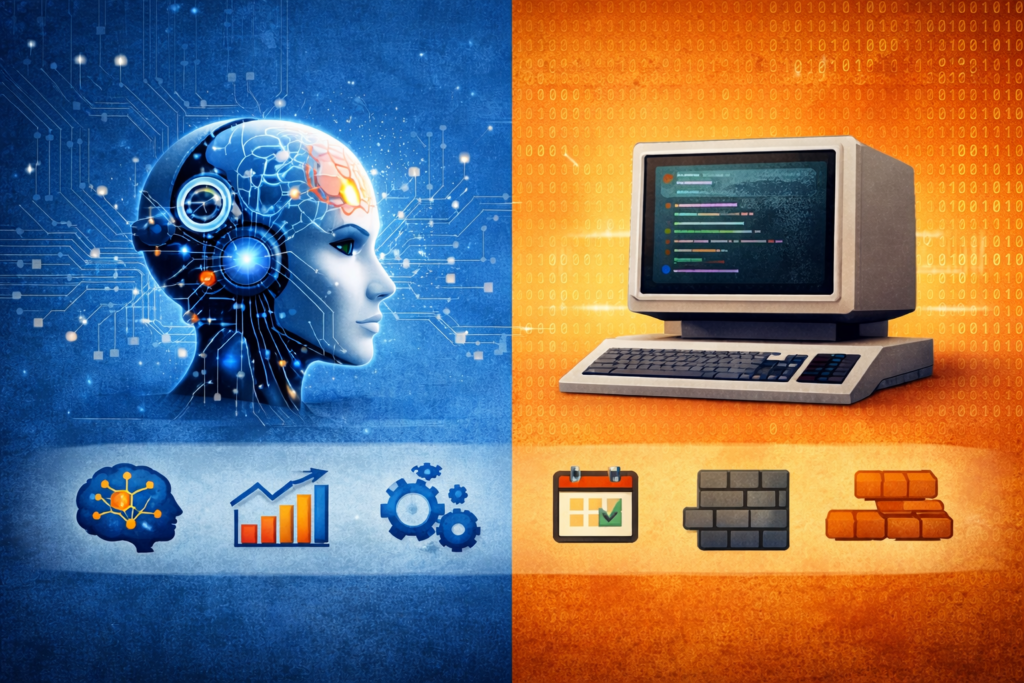
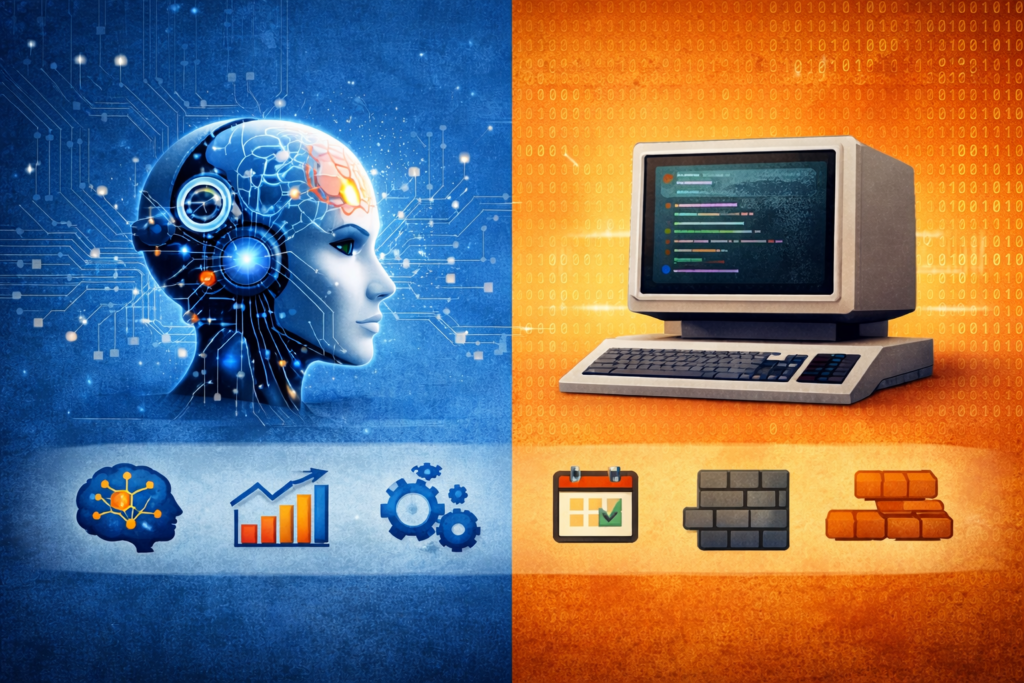
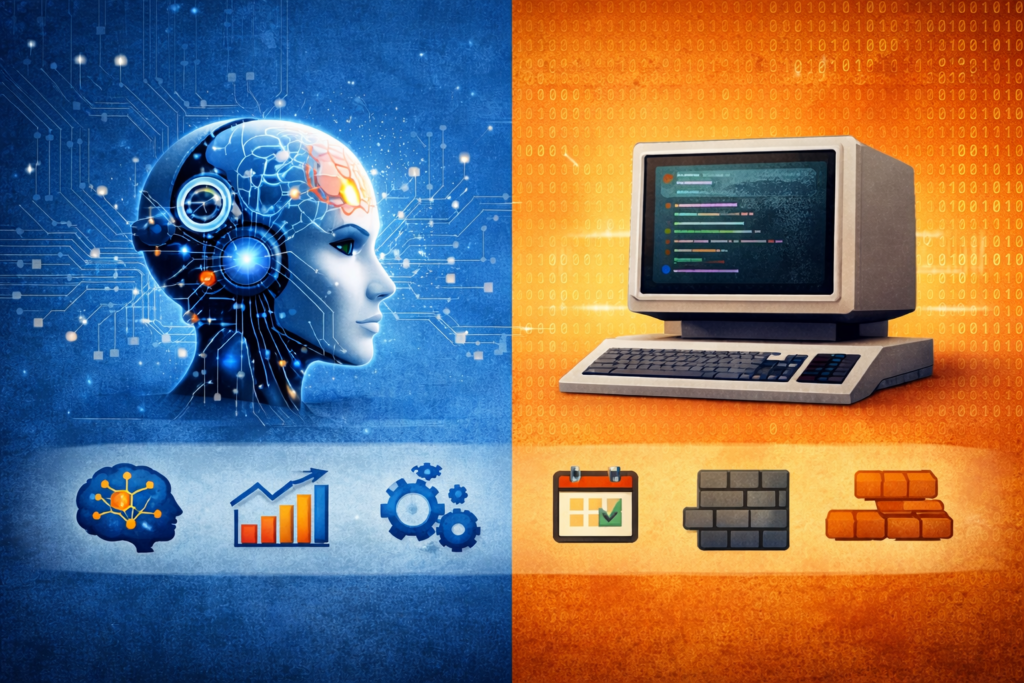
In short, traditional software executes instructions, while AI tools learn, adapt, and make intelligent decisions.
Why It Matters
Understanding the difference between AI tools and traditional software matters because it impacts how we work, learn, and do business.
For businesses, choosing the right technology affects productivity, cost efficiency, customer satisfaction, and long-term growth. Traditional software works well for repetitive and predictable tasks, but it becomes limited when handling complex or changing environments. AI tools can process massive datasets, identify trends, and automate decision-making at scale.
For individuals, AI tools save time and effort. Writing assistance, image generation, voice recognition, and recommendation systems are everyday examples of AI improving personal productivity. Traditional software still has its place, but it lacks the flexibility and intelligence people now expect.
At a global level, AI tools are transforming industries such as healthcare, finance, education, marketing, and cybersecurity. Understanding their strengths and limitations helps users adopt them responsibly instead of blindly replacing traditional systems.
How It Works / Example
How Traditional Software Works
Traditional software operates on if-then logic and predefined workflows.
Example:
- If the user enters “2 + 2”, the calculator outputs “4”.
- If inventory stock is below a set number, the system sends an alert.
The software does not learn from past actions. Any improvement requires manual updates by developers.
How AI Tools Work
AI tools work by training models on data. These models analyze patterns, make predictions, and improve with experience.
For example:
- A recommendation system analyzes user behavior and suggests products.
- A chatbot understands natural language and improves responses over time.
- A fraud detection system learns to identify suspicious patterns automatically.
If you want a deeper explanation of how AI tools function internally, this detailed guide explains it clearly:
https://globaltechspecs.com/how-ai-tools-actually-work-behind-scenes/
Real-Life Comparison Example
Customer Support:
- Traditional software uses fixed response scripts.
- AI tools analyze customer queries, detect intent, and provide personalized responses.
Image Editing:
- Traditional software requires manual edits.
- AI tools automatically enhance images, remove backgrounds, and suggest improvements.
Benefits
Benefits of Traditional Software
- Predictable and stable behavior
- Easier to test and debug
- Lower infrastructure requirements
- Works well for fixed, repetitive tasks
- No dependency on large datasets
Benefits of AI Tools
- Learns and improves over time
- Handles complex and unstructured data
- Automates decision-making
- Provides personalization at scale
- Reduces manual effort and human error
AI tools are especially powerful in areas like data analysis, automation, creativity, and customer experience. When implemented correctly, they can significantly improve efficiency and innovation.
Risks / Limitations
Limitations of Traditional Software
- Cannot adapt to new situations automatically
- Requires frequent manual updates
- Limited scalability for complex tasks
- Not suitable for predictive or intelligent decision-making
Risks and Limitations of AI Tools
- Dependence on high-quality data
- Potential bias in AI models
- Lack of transparency in decision-making
- Higher implementation costs
- Security and privacy concerns
AI tools must be used responsibly, especially when handling sensitive personal or business data. A detailed discussion on AI safety for personal and business use can be found here:
https://globaltechspecs.com/ai-tools-safety-personal-business-2026/
Common Mistakes / Myths
Myth 1: AI Tools Will Replace All Traditional Software
Reality: AI tools complement traditional software, not replace it completely.
Myth 2: AI Tools Think Like Humans
Reality: AI tools simulate intelligence using data and algorithms; they do not have emotions or consciousness.
Myth 3: AI Tools Are Always Accurate
Reality: AI systems can make mistakes, especially if trained on poor-quality or biased data.
Myth 4: Traditional Software Is Obsolete
Reality: Traditional software is still essential for stable, rule-based operations.
Common Mistake: Blindly Adopting AI
Many organizations adopt AI tools without proper planning, data readiness, or understanding of limitations, leading to poor results.
To better understand the evolution of intelligent systems, it helps to explore how AI tools actually work behind the scenes, including concepts like machine learning, data training, and automation
👉 https://globaltechspecs.com/how-ai-tools-actually-work-behind-scenes/
As AI adoption grows, users should also be aware of responsible usage, privacy concerns, and security risks. This detailed guide on AI tools safety for personal and business use explains key precautions and best practices
👉 https://globaltechspecs.com/ai-tools-safety-personal-business-2026/
For a broader, authoritative explanation of artificial intelligence concepts, you can refer to IBM’s official resource on artificial intelligence explained
👉 https://www.ibm.com/topics/artificial-intelligence
To understand the foundations of rule-based applications, this overview of traditional software systems explains how conventional programs are designed and operated
👉 https://www.techopedia.com/definition/4359/software
FAQ Section
1. What is the main difference between AI tools and traditional software?
AI tools learn and adapt using data, while traditional software follows fixed rules.
2. Are AI tools more expensive than traditional software?
Initial costs can be higher, but long-term efficiency often offsets the investment.
3. Can small businesses use AI tools?
Yes, many AI tools are affordable and scalable for small businesses.
4. Is traditional software still relevant today?
Absolutely. It remains essential for predictable and structured tasks.
5. Do AI tools require internet access?
Many AI tools rely on cloud computing, but some can work offline.
6. Are AI tools safe to use?
They are safe when designed responsibly and used with proper security measures.
7. Can AI tools work without data?
No. Data is essential for training and improving AI models.
8. Which is better for beginners: AI tools or traditional software?
Beginners often find AI tools more user-friendly due to automation and smart interfaces.
9. Can AI tools work together with traditional software?
Yes, AI tools are often integrated into traditional software to add intelligence, such as analytics, automation, or personalization features.
10. Do AI tools need regular updates like traditional software?
AI tools may not need frequent manual updates, but they require model retraining and data updates to stay accurate and relevant.
11. What industries benefit most from AI tools?
Industries such as healthcare, finance, marketing, education, manufacturing, and e-commerce benefit greatly from AI tools.
12. Is programming knowledge required to use AI tools?
Many modern AI tools are designed for non-technical users, so basic tasks can be performed without coding knowledge.
13. How accurate are AI tools compared to traditional software?
AI tools can be highly accurate, but their accuracy depends on data quality, training methods, and ongoing monitoring.
14. Can AI tools make decisions without human involvement?
AI tools can automate decisions, but human oversight is still important, especially for critical or sensitive applications.
15. Are AI tools suitable for long-term use?
Yes, when maintained properly with updated data and ethical guidelines, AI tools are suitable for long-term use.
16. What happens if AI tools receive incorrect data?
Incorrect or biased data can lead to inaccurate results, which is why data validation is essential.
17. How do AI tools impact job roles?
AI tools often automate repetitive tasks, allowing humans to focus on creative, strategic, and decision-based roles.
18. Will traditional software disappear in the future?
No, traditional software will continue to exist alongside AI tools, especially where stability and strict rules are required.
Conclusion
The debate between AI tools vs traditional software is not about choosing one over the other, but about understanding when and where to use each. Traditional software excels in stability, predictability, and simple rule-based tasks. AI tools shine in adaptability, learning, automation, and intelligent decision-making.
As technology continues to evolve, the future lies in combining both approaches effectively. By understanding their differences, benefits, and limitations, individuals and businesses can make smarter technology decisions and stay competitive in a rapidly changing digital world.
Disclaimer
This article is for informational and educational purposes only. It does not provide professional, legal, financial, or technical advice. The information presented is based on general knowledge and current technology trends at the time of writing. Readers should evaluate AI tools and software solutions according to their specific needs and consult qualified professionals before making business or technical decisions.